

An L&D budget, short for learning and development budget, is the financial plan that determines how your organisation invests in training, skill-building, and career development for its people.
Get it right and it becomes one of the most powerful levers you have: for retention, performance, and long-term competitiveness. Get it wrong or underfund it, and you feel it in engagement scores, skills gaps, and turnover. This guide covers how to allocate your L&D budget strategically, make the case for it to leadership, and maximise every dollar you have.
Why Your L&D Budget Is a Strategic Investment
A well-structured L&D budget signals to your people that development is a priority. Organisations that treat it as a strategic investment, rather than a discretionary line item, consistently see the returns: stronger engagement, faster onboarding, better retention, and teams that can adapt when the business needs them to. How you allocate that budget matters just as much as how much you spend.
What Should an L&D Budget Include?
To create an effective learning and development budget, you must consider several key components that ensure the funds are allocated wisely and strategically to support diverse learning opportunities, address varying employee needs, and foster professional growth.
A complete L&D budget typically covers:
- Training expenses: external learning opportunities such as professional certifications, industry workshops, and conferences that bring new skills and perspectives into your organisation.
- In-house programs: internally led sessions, knowledge-sharing initiatives, or custom training modules built around your organisation’s specific goals.
- Resources and materials: e-books, online courses, subscription learning platforms, and any digital or physical tools employees need to build skills in their role.
- Technology: learning management systems (LMS), virtual training platforms, and any AI-driven tools that personalise or scale the learning experience.
- Mentoring and coaching: structured programs that connect people across experience levels to share knowledge, develop soft skills, and support career growth.
Why Mentoring Deserves Its Own Budget Line
Most L&D formats are one-directional: an expert delivers content, employees receive it. Mentoring works differently. It draws on the expertise already inside your organisation: experienced people sharing knowledge, perspective, and guidance with those earlier in their careers. This means the value compounds over time rather than ending when a session does.
Mentoring supports the skills that formal training typically can’t: negotiation, leadership presence, stakeholder management, and the kind of cultural knowledge that only comes from experience. It also works alongside your other L&D investments. A good mentor will direct their mentee toward the right internal programs, increasing participation in initiatives you’ve already budgeted for.
Modern mentoring programs extend beyond traditional one-to-one pairings to include peer mentoring, reverse mentoring, and group formats. And with the right platform, they’re significantly more scalable and cost-effective than almost any other investment in your L&D budget and this is why they deserve to be treated as a standalone line item, not an afterthought.
How to Allocate Your Learning & Development Budget for Maximum Impact
Allocating resources for learning and development (L&D) is essentially crafting a strategic blueprint for organizational growth. Each element of your budget must align with your organization’s goals, ensuring maximum return on investment.
Start with a Comprehensive Needs Assessment
Building on the key components of an L&D budget, begin by identifying the most pressing skills gaps across your organization. Use tools like employee surveys, performance evaluations, and industry benchmarking to understand where your workforce is falling short. Are there emerging trends or technologies your teams need to master? Is there a particular group—leaders, new hires, or technical specialists—that requires targeted development?
Prioritize Strategic Areas for Growth
With gaps identified, segment your budget to address the most critical areas. For instance:
- Department-Specific Needs: Allocate more to underperforming or rapidly evolving departments that require upskilling.
- Specialized Training: Reserve funds for high-impact roles needing certification or advanced technical skills.
- Broader Initiatives: Consider company-wide programs like mentoring programs, inclusion training, or leadership development, which benefit the entire organization.
Leverage Blended Learning Models
To stretch your budget and maximize impact, embrace blended learning. Combine in-person workshops with digital resources like e-learning platforms, mentoring, or asynchronous courses. This hybrid model caters to different learning styles, fosters accessibility, and allows employees to learn at their own pace. For instance, supplement group mentoring sessions with online modules to reinforce learning.
Evaluate and Adjust Regularly
Effective allocation isn’t static. Continuously monitor the effectiveness of your investments by gathering feedback and analyzing outcomes. Are employees applying their new skills? Are satisfaction rates improving? Use this data to fine-tune your approach and redirect resources as needed.
Tie Resource Allocation to Long-Term Goals
Resource allocation should directly connect to your organization’s overarching strategy. For example, if your focus is innovation, prioritize programs that build creativity and technical expertise. If retention is a key metric, invest in mentoring programs and leadership pathways to foster employee engagement and career growth.
By strategically aligning your L&D resources with both immediate and future needs, you’re not just addressing skills gaps—you’re setting the foundation for sustained success. After all, a well-structured L&D budget is more than an expense; it’s an investment in your people and your organization’s competitive edge.
How to Justify Your L&D Budget to Leadership
One of the perennial challenges for learning and development professionals is justifying their budget requests to management. This requires a strategic approach that connects investment in employee growth to measurable business outcomes.
To secure buy-in from leadership, connect your investment in employee growth directly to measurable business outcomes. Here are five approaches that work:
- Lead with data. Show how past L&D initiatives moved the metrics that matter: retention rates, time-to-productivity, engagement scores. Quantify the financial impact of reduced turnover or increased efficiency.
- Use success stories. Pair your numbers with a human example. A team member who used leadership training to deliver a critical project is more memorable than a percentage point.
- Tie every request to a business objective. Expanding into new markets? Propose cross-cultural training. Prioritising innovation? Advocate for technical upskilling. L&D investment lands differently when it maps directly to where the business is going.
- Highlight the cost of not investing. Skills gaps don’t stay still, they widen. Outline the downstream risk: project delays, disengagement, and talent attrition.
- Show the numbers visually. A chart comparing the cost of turnover against training investment does more work in a boardroom than three paragraphs of explanation.

How to Balance Cost and Quality in L&D
Striking the right balance between cost and quality can be done with some thoughtful planning.
Often, organizations might shy away from investing in high-quality training or additional programs and initiatives due to budget constraints. However, it’s wise to remember that relaying impoverished training programs or poorly resourced mentoring initiatives only leads to wasted resources and employee frustration.
Consider attending industry conferences or workshops, where you can learn about high-impact, cost-effective options that provide value for money. You can also seek out partnerships with educational institutions or training providers. Collaboration can sometimes lead to favourable pricing while ensuring quality outcomes.
Don’t forget the power of internal talent! Leverage the strengths of experienced team members to lead training sessions and participate in other initiatives. Mentoring can have a profound impact, often at little cost compared to other projects. With a little creativity and resourcefulness, you can ensure your learning initiatives shine brighter than a penny in a well-lit room!
Using Mentoring Programs to Maximize Your Learning & Development Budget
Mentoring is a powerful and cost-effective way to maximize your learning and development (L&D) budget while addressing the skills and growth needs of your workforce.
Whereas training programs can be great for learning hard skills, a mentor can help guide self-driven learning and teach the skills that are not so easily acquired: soft skills. From negotiation and public speaking to organisation and management chops, your experienced team members may be the best people to impart these to other employees as they already understand the company’s unique culture and challenges.
In order to leverage these people who are already a part of your company, your organisation can implement a mentoring program cost-effectively for a fraction of your L&D budget. For example, the cost of the Mentorloop mentoring platform is a slither of most organisations’ professional development budgets, opening the door for a huge reward.
Why Mentoring?
According to the Chartered Institute of Personnel and Development (CIPD)’s Learning and Development Survey, coaching and/or mentoring is seen as one of the most effective approaches, as are ‘in house development programmes’ which usually include a large coaching element. The survey also found that some examples of situations where coaching/mentoring is a suitable development tool include when it comes to:
- Dealing with the impact of change on an individual’s role
- Supporting an individual’s potential and providing career support
- Helping competent technical experts develop better interpersonal skills
- Developing a more strategic perspective after a promotion to a more senior role
- Handling conflict situations so that they are resolved effectively
However, it’s important to note that coaching/mentoring isn’t suitable for everyone. If an individual lacks self-insight or is resistant to mentoring, for example, it may not be the appropriate intervention.
Therefore, it’s important that organisations assess individuals’ readiness for involvement in a mentoring program before they become active participants. Mentees must not only be ready and willing to be mentored, but they must also be motivated to achieve the desired outcome.
The Tangible Benefits
Mentoring programs unlock potential beyond immediate skill development.
For example, mentees may gain insights into areas for improvement, or even new skills they need to learn through their mentors. They could also learn about a conference they should go to, or get an introduction to a client they might bring on board. This could mean more developed in-house talent, more exposure for the company, and even new business.
Another great example of the benefit of mentoring programs is that mentors are able to direct mentees towards the right in-house training programs for them, therefore increasing participation in initiatives you’ve already allocated budget for. Additionally, gaining different perspectives from their mentees can keep mentors sharp and in touch with new developments in their industry or areas of specialization and beyond.
These outcomes contribute to a stronger, more dynamic workforce, with benefits that ripple across the organization.
A Cost-Effective Investment
Table 1 — Average cost per person of different L&D solutions
| L&D solution | Avg. cost per person* |
|---|---|
| Exec coaching session | $4,760 |
| In-person training session | $2,613 |
| Online leadership course | $1,085 |
| Online learning subscription (per month) | $23 |
| Mentorloop (per month) | $7 |
*All costs calculated by averaging ≥4 suppliers
Ultimately, the costs of a formal mentoring program are far outweighed by the rewards.
By leveraging the expertise of your existing employees, a mentoring program can deliver significant returns at a fraction of the cost of traditional L&D initiatives.
Platforms like Mentorloop enable organizations to implement scalable and efficient mentoring programs without straining their budgets.
And with Mentorloop’s competitive pricing, this means that any HR or People & Culture team can roll out mentoring to more people, for a much lower price – making a program more scalable and accessible for people at different levels of the organisation.
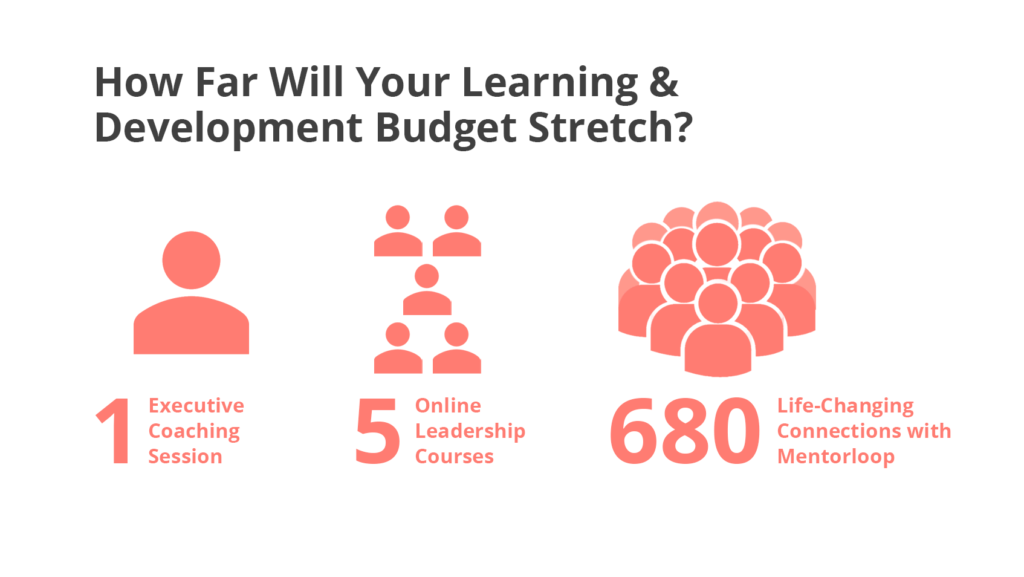
For comparison, a Mentoring Program with Mentorloop is 680 times cheaper than executive coaching and 373 times cheaper than an in-person training session.
Below is a more in-depth breakdown.
L&D cost comparison
Per-participant cost · scalability · best fit
Cost comparisons based on Mentorloop internal data. Individual costs will vary by organisation size, provider, and program structure.
With the average learning and development allowance for an individual employee sitting around $1200, why invest in a one-off experience when you could provide them with multiple life-changing connections for the cost of a coffee?
Frequently Asked Questions About Maximizing Your Learning & Development Budget
What is a good L&D budget per employee?
Benchmarks vary by industry and organisation size, but according to Training Magazine, the average is around $874 per employee per year. That said, the more important question is how the budget is allocated — a well-structured mentoring program, for example, can deliver significant returns at a fraction of the cost of traditional training.
How do I calculate the ROI of my L&D budget?
Start by identifying the outcomes you’re targeting (e.g. retention, time-to-productivity, engagement) and establish a baseline before a program begins.
After the program, measure the delta and attach a dollar value where possible (e.g. reduced turnover cost). For mentoring programs specifically, look at engagement survey results, internal promotion rates, and program completion rates as leading indicators.
What should I prioritise if my L&D budget has been cut?
Focus on high-impact, low-cost interventions first. Mentoring programs leverage your existing internal expertise and typically cost a fraction of external training. Identify which skills gaps are most urgent for business performance, and consolidate spend there rather than spreading a reduced budget thinly.
Is mentoring part of an L&D budget?
Yes! And it’s often one of the most cost-effective line items in it. Mentoring programs support soft skill development, leadership pathways, and knowledge transfer in ways that formal training can’t replicate. They can also increase participation in other L&D initiatives by helping employees identify the right programs for their goals.
How do I get leadership to approve a larger L&D budget?
Frame it as a business case, not a training request. Quantify the cost of inaction (turnover, skills gaps, stalled projects), tie your ask to specific strategic goals, and use data from past programs to demonstrate proven ROI. Visuals and forecasts tend to land better than narrative-heavy proposals in budget conversations.
Maximise your learning budget by leveraging the talent that lies within your organisation. Encourage people to share knowledge and experience with one another for a powerful, engaged community. Build a culture of mentoring at your organisation, with Mentorloop.