
The modern career is no longer a straight line, and for many professionals, that’s the point. A portfolio career means holding multiple roles, income streams, or projects simultaneously, and in 2025, it has moved firmly from niche strategy to mainstream reality. Technology, shifting values, and economic uncertainty have all accelerated the shift.
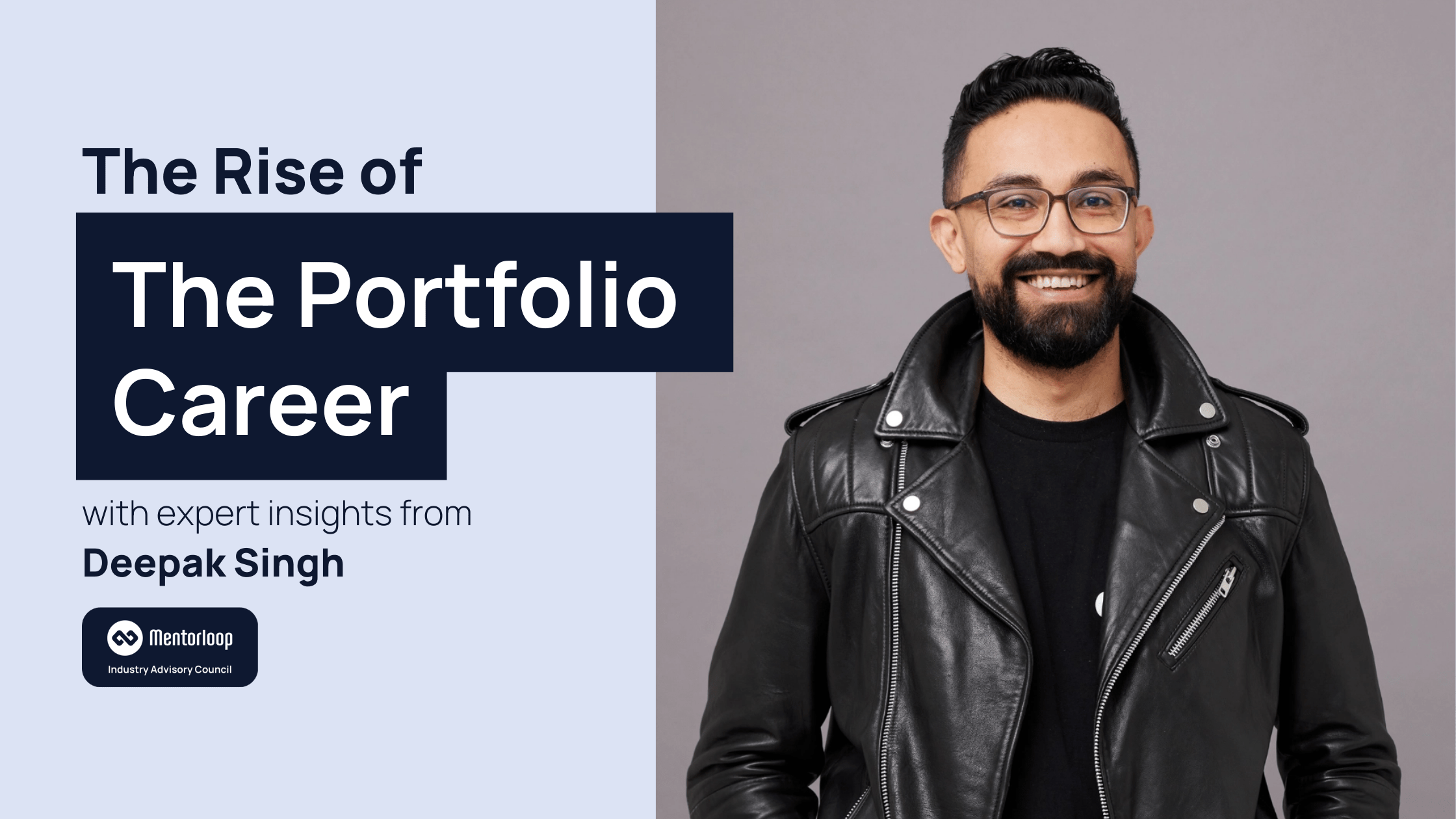
In this article, we explore what a portfolio career looks like today, who’s adopting it, the benefits and trade-offs, and practical advice for making it work, including the critical role mentoring plays in accelerating success. Throughout, we’re joined by Deepak Singh, founder of Mission and Rhythm and a member of the Mentorloop Industry Advisory Council, who shares what this way of working actually looks like from the inside.
What is a Portfolio Career?
A portfolio career means holding multiple roles or income streams at once rather than relying on a single full-time position. Those streams can include part-time jobs, freelance projects, creative endeavors, consulting, passive income, teaching, or business ventures. The goal here is diversification: of income, skills, and professional identity.
This model matters because work itself is changing. A record 8.9 million Americans reported holding multiple jobs in early 2025 — the highest figure since tracking began in 1994, according to the Bureau of Labor Statistics. More broadly, over one-third of the US workforce now participates in some form of freelance or independent work. These shifts reflect a broader reimagining of work around flexibility, autonomy, and resilience.
Embracing a portfolio career also allows individuals to tailor their professional lives to their personal values and interests. Instead of being confined by a single employer’s agenda, people can pursue projects that truly excite them, develop a broader skill set, and adapt more quickly to market changes. This adaptability can be especially vital in times of economic uncertainty or rapid technological disruption.
A portfolio career also often offers enhanced work-life balance by enabling more control over scheduling and work environments. Professionals can allocate time to different roles in ways that suit their energy levels, family commitments, or creative rhythms. This flexibility can improve job satisfaction and overall well-being, further fueling motivation and productivity across all income streams.
For Deepak Singh, Mentorloop Industry Advisory Council member and founder of Mission and Rhythm, the appeal is less about juggling multiple things and more about what that range makes possible.
Deepak Singh shares his take on what a portfolio career actually looks like from the inside and why it’s more focused than it appears.
What's Driving the Rise of Portfolio Careers?
Several factors are converging to make portfolio careers both attractive and feasible. Digital platforms and remote-first tools remove geographic constraints and lower the transaction cost of taking on multiple gigs. Economic uncertainty, recessions, industry disruption, or employer restructuring, has made diversification a practical hedge. And cultural changes, especially among Gen Z and Millennials, place a higher value on autonomy and more meaningful work.
Of course, technology plays a central role: marketplaces for freelance work, creator platforms, and automation tools make it simpler to manage multiple income sources without splitting attention across dozens of disconnected systems. Meanwhile, employers increasingly hire for flexible roles; fractional executives, part-time specialists, and project-based teams, that fit portfolio lifestyles.
Who Is Choosing Portfolio Careers And Why?
Younger cohorts are most visible in the movement. Gen Z and Millennials often prioritize flexibility and alignment with personal values, and many treat portfolio working as a deliberate strategy to gain varied experience rather than a stopgap. Regions with large gig economies, such as India, where the gig workforce is forecast to grow substantially, also reflect this global shift. In India, for instance, NITI Aayog projects the gig workforce will grow from 7.7 million to 23.5 million by 2029–30.
It’s worth noting though, that not every portfolio career begins as a strategic choice. For many, it starts with necessity: a gap between roles, an unexpected redundancy, or simply a first freelance project that leads to another. Deepak shares that he didn’t necessarily set out to design a portfolio career early on, but was drawn to work that evolved into what his career looks like today. “Someone said, ‘Can you help me with this?’ I did. Then someone else said the same. And then I thought, I better get an ABN so I can actually get paid.” What begins as pragmatism often evolves into something more intentional over time. As Deepak puts it: “It’s not necessarily a lifestyle choice, it’s more a capability choice.”
What Are The Benefits Of A Portfolio Career?
Portfolio careers offer tangible benefits that go beyond novelty. Financially, multiple income streams reduce dependency on a single paycheck, smoothing cash flow during market dips. Professionally, juggling diverse roles accelerates skill acquisition and broadens networks. Psychologically, alternating between different types of work can keep motivation high and reduce burnout tied to monotony.
For many, portfolio working is a pathway to greater control over time and projects. It allows selective commitment—choosing projects that match values or stretch skills—while keeping a safety net of other engagements. For organizations, engaging with portfolio professionals brings access to specialized skills without long-term hiring commitments.
Cross-industry experience is another benefit that’s easy to underestimate. Exposure to different sectors surfaces patterns that specialists embedded in a single industry often miss. Deepak frames it simply: “My career didn’t diversify for distraction, it diversified to give me perspective, and that’s made me better at each thing I do.”
What Are The Challenges Of A Portfolio Career?
Portfolio careers are not a magic solution. Time management becomes a core competency: coordinating deadlines, invoicing, client expectations, and personal life requires discipline and systems. Income variability is another hallmark—earnings can be uneven, which calls for budgeting, emergency savings, and sometimes multiple financial strategies (retainer agreements, recurring products, passive income).
Legal and tax complexity increases with multiple payers and international clients. Navigating contracts, benefits, health insurance, and retirement planning requires either self-education or professional advice. There’s also an emotional toll: identity diffusion, issues convincing traditional employers of commitment, and the pressure of constantly marketing oneself.
That psychological dimension deserves particular attention. The structural challenges of a portfolio career are manageable with the right systems, but the internal shift is often what catches people off guard. For those moving into this way of working for the first time, building that psychological foundation is just as important as building the business one. As Deepak puts it: “The biggest shift isn’t structural, it’s psychological. You move from being defined by a role and a set salary to being defined by value and creating that value. That requires confidence, clarity, and persistence.”
Is A Portfolio Career Right For You?
Consider risk tolerance, personal responsibilities, and long-term goals. Is there a need for stable monthly income (e.g., dependents, mortgage)? Are there transferable skills that can be packaged into services or supportable side projects? A staged approach—starting a side income while keeping a primary role—often works better than an abrupt leap.
The Commitment Myth: Are Portfolio Professionals Less Dedicated?
One of the most persistent barriers portfolio professionals face is perceptual. There’s a widespread assumption that working across multiple engagements signals divided loyalty or lack of commitment, and many portfolio workers feel pressure to conceal parts of their work as a result.
Deepak pushes back on this directly.
“The biggest myth about portfolio professionals is a lack of commitment. In 2026, putting your entire professional identity and income into one organization is actually a bigger risk than strategic diversification. Portfolio professionals aren’t less committed, we’re committed to outcomes over optics.”
That misalignment between perception and reality creates a culture of unnecessary secrecy, and often it says more about the organization than the individual.
Deepak Singh shares his thoughts on why portfolio professionals may hide their work and what it signals about organizational culture maturity.
How Should Organizations And Portfolio Professionals Work Together?
The good news is that the conditions for a healthier relationship between portfolio professionals and organizations aren’t complicated. They just require intentionality from both parties.
There’s also a power dynamic at play that’s rarely discussed openly. A portfolio professional with diverse income streams and a strong external reputation enters any working relationship with more balance than someone entirely financially dependent on a single employer. Far from being a threat, this can actually create healthier dynamics: better conversations, more honest feedback, and relationships based on mutual value rather than economic necessity. “If you can balance that power,” says Deepak, “greater outcomes happen.”
For organizations, three things make the biggest difference.
- A clear conflict-of-interest framework removes ambiguity and gives everyone a shared reference point. This makes disclosure a process, not a gamble.
- Outcome-based expectations are non-negotiable. If you’re engaging someone whose attention is genuinely split, the conversation has to be anchored in what they’ll deliver, not when or where they’ll show up.
- Perhaps most importantly, psychological safety around disclosure needs to be actively designed, not just assumed. People should feel comfortable being honest about how they work and what they need, including the flexibility to do so.
For portfolio professionals, the obligations are equally clear.
- Radical transparency is the foundation. Be upfront about engagements, boundaries, and potential overlaps before they become issues.
- That transparency needs to be matched with genuine discipline: strong respect for IP, careful separation of what belongs to whom, and a consistent alignment on outcomes that makes the relationship feel fair rather than extractive. As Deepak frames it, you cannot be taking what’s great from one organization and applying it somewhere else. Portfolio professionals need to be mature and disciplined enough to honour each relationship on its own terms.
Building a Sustainable Portfolio Career: A Practical Roadmap
Creating a portfolio career that lasts means treating it like a business. Begin with a simple financial baseline: know monthly expenses, calculate a conservative income target, and build a three- to six-month emergency fund. Next, map skills and market demand: what services can be offered now, what skills need upgrading, and which audiences are reachable.
Systems matter. Use a unified calendar, invoicing tools, a task manager, and simple accounting software. Automate recurring tasks and set firm boundaries to prevent rolodex chaos. Financially, mix short-term cash gigs with longer-term retainers to smooth revenue.
Deepak distils his practical advice into four principles:
Build depth. Whether it’s a specific area of expertise, an ideal client set, or a professional network, breadth gets attention but depth builds a sustainable career.
Deliver obsessively. Reputation is the portfolio professional’s most valuable asset. Consistent, high-quality outcomes create the referrals and repeat work that smooth out income variability over time.
Get financially stable and be patient. This is rarely quick. A portfolio structure can help bridge the gap, allowing for smaller engagements to stack while the bigger picture takes shape.
Design your week with discipline. Without a traditional structure imposed from the outside, the rhythm has to come from within. Intentional scheduling is what separates momentum from chaos.
And remember: there’s no single right path into this. Some people plan it deliberately; others, like Deepak, register an ABN because the bills need paying and someone asked for help. Both are valid starting points.
As Deepak puts it, even if your first attempt goes nowhere, it can still be a fun project that allowed you to flex some muscles and learn along the way. “It still goes somewhere. It makes you more focused, makes you sharper, and helps you define: can I do this, can I not, can I try?”
Deepak Singh shares some practical advice he finds himself coming back to and talks about why persistence matters more than having a perfect plan.
How Do You Choose The Right Mix Of Work In A Portfolio Career?
Variety reduces risk, but too much variety creates complexity. Aim for a balanced portfolio: one predictable income stream (part-time job or retainer), one growth stream (skills-building project or course sales), and one high-upside bet (startup equity, creative work, or consultancy). Adjust that mix as life priorities and market opportunities evolve.
Deepak adds a useful lens here: portfolio careers have a way of amplifying whatever’s already there. Focus, then, isn’t just a time-management tactic, it’s what determines whether variety becomes strength or noise.
Deepak Singh shares why focus is such an underrated skill in a portfolio career and talks about what he learned the hard way.
Mentoring and Mentoring Programs: Accelerating Growth
Mentoring plays an outsized role in helping portfolio professionals scale faster and avoid costly mistakes. Experienced mentors can provide market insights, help refine service offerings, and open doors to clients and collaborations. Mentorship also offers accountability—crucial when juggling multiple priorities without a traditional boss.
Formal mentoring programs, whether they’re run by industry associations, community groups, coworking spaces, or online platforms, provide structure. Many programs match mentees with mentors for defined timeframes, include goal-setting sessions, and offer peer cohorts for additional support. These frameworks help beginners navigate tax questions, pricing strategies, and client negotiation tactics.
For portfolio professionals specifically, mentorship takes on an added dimension: it helps with the identity shift, not just the strategy. “Mentors don’t necessarily have to have had a portfolio career themselves,” says Deepak, “but what helped me was mentors who’d built their own businesses; and also having really strong informal mentoring networks with people in a similar situation. Because you understand that identity, and that evolution of identity.”
Peer mentoring — connecting with others navigating the same terrain in real time — can be just as valuable as more formal arrangements, particularly in the early stages when the psychological foundations are still being built.
Deepak Singh shares why mentorship is incredibly important when you’re redefining your professional identity as well as your career structure.
How To Find And Use A Mentor Effectively
Look for mentors with complementary experience and clear expectations. Prepare specific questions, share progress updates, and treat mentorship as a professional commitment. Short-term mentorship sprints focused on tangible outcomes—pricing, pitch decks, or contract templates—often yield high ROI. Peer mentoring groups can also be invaluable for solving operational challenges together.
Which Skills Should Portfolio Professionals Prioritise?
One of the strongest advantages of a portfolio career is the ability to curate continuous learning. The market rewards T-shaped professionals—those with deep expertise in a core area and broad skills across adjacent domains. This combination makes it easier to cross-sell services and adapt when demand shifts.
Skill-investment choices should be intentional. Prioritize skills that unlock higher rates (business development, negotiation, domain expertise) and scalable products (online courses, templates, or subscription services). Microcredentials and short, project-based learning often deliver practical returns faster than lengthy degrees.
What Do Portfolio Careers Look Like in Practice?
Across sectors, distinct patterns are visible: marketing professionals combining consulting with content creation; software developers taking on part-time engineering roles alongside freelancing; and designers offering retainers for UX work while selling templates. The result is a more modular labor market where talent moves fluidly between projects and organizations.
Market signals support this trend. The rise of fractional roles and platforms that facilitate multiple income streams shows organizational receptivity. The global gig economy, valued at $556.7 billion in 2024, is projected to reach over $2 trillion by 2033 — suggesting the portfolio model will continue to scale.
How Can Organizations Engage and Retain Portfolio Talent?
Firms can benefit by designing roles that attract portfolio professionals: defined deliverables, flexible hours, and clear scopes with fair compensation. Cultivating short-term project pipelines, offering performance-based pay, and maintaining talent pools for re-engagement helps organizations tap specialized skills while providing predictable work for independents.
For teams, onboarding micro-contractors with clear processes and communication norms reduces friction. Investing in mentoring arrangements—internally or via external programs—helps integrate portfolio professionals and upskill internal staff simultaneously.
The challenge many organizations face, though, is that they treat portfolio capability as a policy issue rather than a systems design problem. Hiring flexible talent is only half the equation; the organization’s own operating model needs to be ready to unlock what that talent can do. Most organizations, in Deepak’s view, aren’t quite there yet but the direction of travel is clear.
Deepak Singh discusses why portfolio talent is leverage, but it only works effectively if an organization is designed to use it well.
Questions For Organizational Leaders
What roles in the organisation could be reframed as fractional or project-based without losing continuity?
How can compensation and performance systems be redesigned to reward contribution rather than hours logged?
And critically: does your culture create the psychological safety for portfolio professionals to be transparent about how they work, or does it quietly incentivise secrecy?
How to Get Started with a Portfolio Career: Practical Next Steps
Start small and structured. Test one side income for at least three to six months before scaling. Track time and earnings closely to understand real margins. Build an online presence that clarifies services and niche audiences. Case studies and testimonials are more persuasive than broad claims.
Network intentionally: join industry groups, participate in mentoring programs, and collaborate with peers who can refer work. Treat the portfolio as a brand: consistent messaging, clear offers, and streamlined client onboarding reduce the cognitive load of switching between roles.
One practical starting point that’s often overlooked: get specific about what you actually love doing within your domain. Most fields contain multitudes: tasks that energise and tasks that drain. Building around what energises you, rather than just what you’re capable of, gives your portfolio career a far stronger foundation.
Deepak Singh shares why using what you love as a compass for designing your portfolio career is the way to go.
What Does The Future of Portfolio Careers Look Like?
Portfolio careers are reshaping the labour market in ways that will continue to unfold. Their growth reflects both technological enablement and deeper shifts in what people want from work: autonomy, variety, and resilience. This path is not without trade-offs — time management, financial variability, and administrative complexity — but for many, the benefits outweigh the drawbacks.
The framing that perhaps captures it best comes from someone living it: portfolio professionals aren’t less committed than their traditionally employed counterparts. They measure success by results, not presence — and for organisations willing to meet them on those terms, the opportunity isn’t just access to flexible talent. It’s access to people whose entire working life has been built around delivering results.
Which of the benefits — flexibility, skill growth, financial diversification — matters most for your personal goals? What small step could you take this month to test a new income stream or connection?
Resources and Where to Go from Here
Look for local and online mentoring programs, industry-specific cohorts, and community platforms that support portfolio professionals. Use basic accounting software, a unified calendar, and simple contract templates to reduce friction. Seek mentors who can help refine pricing and positioning to accelerate momentum.
As work continues to evolve, the portfolio career offers a flexible, resilient path for building a meaningful and sustainable professional life. Thoughtful planning, continual learning, and the right relationships—especially mentoring—make the difference between a chaotic hustle and a strategic career design.
Take the Next Step with Mentorloop
One of the most consistent themes in a successful portfolio career isn’t strategy, it’s identity. The shift from being defined by a role to being defined by the value you create is psychological as much as practical, and it’s one of the places where the right mentoring relationship makes the biggest difference.
At Mentorloop, we help organisations build mentoring programs that connect people to the perspectives they actually need; whether that’s someone who has built their own business, navigated a career pivot, or simply understands what it means to define yourself by outcomes rather than a title. For portfolio professionals, this kind of mentoring provides not just tactical guidance on pricing or pitching, but the accountability and identity anchoring that makes the transition sustainable.
If your organisation is engaging portfolio talent or supporting your people through evolving ways of working, Mentorloop gives you the infrastructure to make those relationships work at scale, with structure, and with the matching intelligence to connect the right people at the right time. Book a Demo today to see how.