

Picture this: A 35-year veteran cardiologist, announces her retirement. She’s served on your medical association’s clinical standards committee for over two decades. She knows how to determine which pharmaceutical reps can be trusted, how to navigate the most complex ethical situations, and exactly why certain protocols evolved the way they did. She’s mentored countless colleagues informally over coffee at conferences. When she retires, and leaves behind her association membership, all of that goes with her, and your profession is poorer for it.
This isn’t just one association’s problem. It’s happening across industries right now. The baby boomer generation, keepers of decades of professional wisdom, is retiring en masse. And we’re facing a silent crisis: losing not just experienced practitioners, but the deep expertise that elevates entire professions. In the face of this, association mentoring programs may be the most effective solution we’re not fully utilizing.
The Great Resignation Meets the Silver Tsunami
Across professions, from engineering to healthcare, legal services to accounting, a significant portion of the most experienced practitioners are nearing retirement age. These aren’t just any professionals. They’re the ones who:
- Lived through major industry transformations and understand not just what changed, but why
- Developed specialized skills over decades that can’t be learned in a weekend workshop
- Hold the institutional memory of professional standards and best practices
- Built the networks that make industries function smoothly
The gap they’re leaving behind isn’t something the next generation can simply “figure out” through trial and error. The cost of losing the knowledge and context behind professional standards, client outcomes, and industry excellence is too high.
Beyond the Textbook: The Knowledge That Defines a Profession
When experienced professionals retire, what exactly are we losing? It’s not just the credentials on their wall.
Technical Expertise That Goes Beyond Certification
There’s specialized knowledge that takes decades to develop. You see it in the engineer who can look at a bridge design and spot the subtle flaw that computer models might miss, the nurse practitioner who knows exactly how to adjust treatment protocols for edge cases that never made it into the textbooks, and the accountant who understands not just current tax code, but the history of why certain loopholes exist and how they’ve been exploited.
This is the understanding of the “why” behind best practices—knowledge that helps professionals adapt to new situations rather than just following scripts. It includes pattern recognition across thousands of cases, the ability to see connections others miss, and expertise in handling the exceptions that prove the rules.
Professional Wisdom That Can't Be Standardized
Then there’s the judgment that develops only through experience. How do you navigate ethical gray areas where the rulebook gives conflicting guidance? How do you manage difficult client or stakeholder relationships? What do you do when you face a complex situation with no clear playbook?
Senior professionals have encountered countless scenarios that taught them when standard approaches work and when they don’t. They’ve made mistakes, learned from them, and developed the judgment to handle ambiguity. They know when it’s appropriate to challenge conventional thinking and when to follow established protocols to every last letter.
Industry Cultural Knowledge
Finally, there’s the understanding of how your profession actually works beyond the official channels. The unwritten professional norms and expectations that govern credibility. How to build a reputation in the field. Why certain industry standards exist and how they evolved. How to navigate professional networks and relationships effectively.
This cultural knowledge—understanding the “how things really work” of your industry—is what helps professionals be effective, not just competent. It’s what transforms someone who passed the exams into someone the profession trusts and respects.
The Limits of Formal Learning
Most associations recognize they have a knowledge transfer problem. So they’ve invested in solutions: comprehensive procedure manuals, annual conferences, certification courses, webinar series. These are valuable. But they’re not enough.
The Documentation Trap
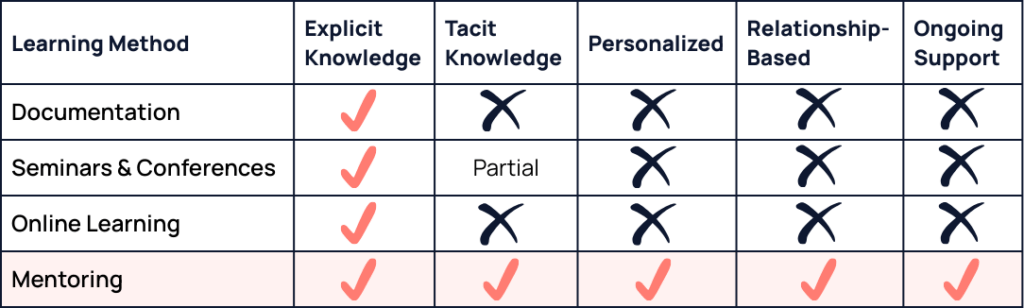
Documentation captures explicit knowledge—the facts, procedures, and step-by-step processes—beautifully. But it fails at transferring tacit knowledge: the intuitive understanding that experienced professionals have developed but often can’t fully articulate.
When a seasoned professional says “this situation feels off” or “I have a gut feeling we should approach this differently,” they’re drawing on tacit knowledge: that pattern recognition and contextual understanding they’ve built over years.
The thing is: you can’t document a gut feeling.
You can’t write a procedure manual for professional intuition. Documents also can’t answer follow-up questions or adapt to your unique situation. They present information as static truth rather than living wisdom that evolves with context. And perhaps most critically, they can’t help you understand which parts of the written guidance apply to your specific circumstances and which don’t.
Seminars and Conferences: Valuable But Limited
Your annual conference brings in expert speakers who share cutting-edge insights. Your quarterly seminars dive deep into emerging issues. These serve an important purpose. They expose professionals to new ideas and create opportunities for networking.
But the one-to-many format has inherent limitations. A conference keynote can introduce concepts, but it can’t personalize advice to your career path. A seminar can present best practices, but it can’t help you navigate the specific political dynamics of your workplace. Workshop presenters share their experiences, but there’s no ongoing relationship for follow-up when you try to apply those lessons and encounter obstacles.
Time constraints mean even the best conference sessions skim the surface of complex topics. The nuanced judgment calls, the “war stories” that teach what really happens when theory meets reality—there’s rarely time for the depth these require.
Online Courses:Structured But Impersonal
The explosion of online learning has made professional development more accessible than ever. Professionals can earn certifications, complete compliance training, and learn new technical skills without ever leaving their desk.
But standardized content can’t address individual career trajectories. A course on project management presents universal principles but it can’t help you figure out how to manage your specific team with its unique personalities and politics. Self-paced learning provides flexibility, which is great, but it allows for no accountability or personalized guidance when you get stuck. And courses focus on explicit knowledge, the “what” and “how”, while struggling to convey the “why” and “when” that comes from experience.
Perhaps most significantly, these methods can’t replicate the relationship-building aspect of professional development. They don’t connect you with someone invested in your growth who can provide encouragement, reality checks, and introductions to the right people at the right time.
Now let's compare these approaches with mentoring:
Why Association Mentoring Programs Succeed Where Other Methods Fall Short
For associations looking to address the knowledge transfer crisis, structured mentoring programs offer something your other professional development offerings simply can’t replicate.
Building Belonging in a Professional Community Retains Members
Association mentoring programs create the kind of meaningful professional connections that strengthen both individual careers and your entire membership community. When members have mentors within the association, they develop deep ties to the profession and to your association itself.
This matters enormously for retention. Despite your efforts with running events, creating industry-leading content, and constant association-to-member communication, members still feel isolated. They attend the conferences but never form lasting connections and relationships. They consume the content and read your communications but have no one to discuss it with. This means they’re more likely to let their memberships lapse.
This is where mentoring excels. Mentoring transforms passive members into engaged participants who see your association as central to their professional identity.
The benefits extend beyond keeping members on the roster. Mentored professionals are more likely to volunteer for committees, contribute to publications, attend events, and eventually become mentors themselves. You’re not just retaining members, you’re cultivating the next generation of association leaders and engaged contributors.
Facilitating Knowledge Transfer Across Your Membership
Your association sits on an incredible wealth of expertise distributed across your membership base. The challenge is connecting those who have knowledge with those who need it—at the right time and in the right way.
Structured mentoring programs create systematic pathways for this knowledge transfer. Instead of hoping members will network organically at your annual conference, mentoring ensures that early-career professionals actually connect with experienced practitioners who can guide them, or that peers going through the same thing at their own companies can form peer mentoring relationships and help each other through common challenges. It creates relationships where knowledge sharing happens through dialogue, questions, and real-world application.
The tacit knowledge that documentation and courses struggle to convey—professional judgment, industry cultural norms, nuanced decision-making—gets transferred organically through mentoring conversations. When a mentee asks their mentor “how would you handle this situation?”, they’re accessing decades of pattern recognition and contextual understanding that no manual could capture.
Amplifying Your Existing Professional Development Offerings
Smart associations don’t position mentoring as replacing conferences, courses, or other programming. They position it as the connective tissue that makes everything else more valuable.
That keynote speech at your conference? Members with mentors discuss how to apply those insights to their specific contexts. Your new certification program? Mentees get guidance from their mentors on how to leverage it for career advancement. Your technical documentation? Instead of sitting unread, it becomes a resource that mentors and mentees explore together.
Mentoring creates personalized support that helps members extract maximum value from all your association’s offerings. It’s the difference between consuming content and truly learning from it.
Creating Value That Differentiates Your Association
In a landscape where professionals can access information from countless sources, associations need to offer something distinctive. This is key. Lack of perceived value is the #3 reason members do not renew memberships. And with only 11% of associations able to describe their value proposition as “very compelling,” therefore threatening retention and recruitment, demonstrating the value of your membership is crucial.
Structured mentoring programs provide you with a benefit that members genuinely can’t get elsewhere.
Yes, professionals can find mentors informally. But when left to just happen organically, this only favours those who already know how to play the networking game. And that’s not everyone. Your association can facilitate matching at a scale individuals can’t achieve on their own, connecting members across geographic boundaries and organizational silos. You can provide structure and support that helps mentoring relationships thrive rather than fizzle out after an awkward coffee meeting. You can recognize and credential participation in ways that matter professionally.
For members considering whether to renew, access to a structured mentoring program is a tangible, valuable benefit. In fact, mentoring programs are now the second-highest area of engagement growth for associations, behind only social media participation.
For prospective members, it’s a compelling reason to join. And for your association, it’s a program that directly supports your core mission: advancing the profession by developing its practitioners.

Through our mentorship programme, we’re gaining new members and also raising engagement with our current members. And it’s actually cited as one of the primary reasons that many members join our association.
- Meera Tailor, Training and Mentorship Coordinator,

Generating Content and Insights From Member Expertise
An underappreciated benefit of mentoring programs: they surface valuable content and insights from your membership that can benefit the broader community.
As mentoring pairs discuss challenges and solutions, patterns emerge about what professionals in your industry are struggling with. These insights can inform your content strategy, event programming, and advocacy priorities. Because like what was already said above, mentoring is here to enhance your other offerings, not replace it.
Mentors often have expertise worth sharing more widely. Your mentoring program becomes a talent identification system for potential conference speakers, publication contributors, and thought leaders.
Some associations facilitate group mentoring sessions where multiple mentees learn from a senior professional, or create opportunities for mentoring pairs to share key lessons (with appropriate privacy protections, of course). The knowledge transfer happening in individual mentoring relationships will, when amplified thoughtfully, benefit your entire membership.
What Effective Association Mentoring Looks Like
If we’ve now convinced you that mentoring matters, the next question we know you’re asking is: what separates mentoring programs that transform professional development from those that fizzle out after a few awkward coffee meetings?
Glad you asked!
Strategic Matching at Scale
Random pairing where you just go, “here’s your mentor, good luck,” rarely works. Effective programs match based on multiple factors: technical specialty, career stage and goals, geographic location if relevant, etc.
This sounds complex, especially for larger associations. How do you thoughtfully match 100 mentor-mentee pairs? This is where technology becomes essential. Modern mentoring platforms use algorithms to suggest matches based on detailed profiles, goals, and preferences. They enable sophisticated matching at a scale that would be impossible manually.
The goal isn’t perfection. It’s finding matches with enough common ground and complementary experience that both parties are invested in making the relationship work.
Structure With Flexibility
The best mentoring relationships need both guardrails and freedom. Structure without flexibility feels bureaucratic and stifling. Flexibility without structure means relationships drift and fade.
Effective programs provide:
- Clear goals tied to professional competency development (what does the mentee hope to achieve?)
- Recommended meeting cadence (monthly is often the minimum for maintaining momentum)
- A timeframe (6-12 months gives enough time for real development while avoiding open-ended commitments)
- Frameworks that guide conversations (discussion prompts, reflection exercises) while allowing the relationship to evolve organically
Mentoring platforms can facilitate this structure through goal-setting tools, meeting reminders, conversation guides, and progress tracking. All of this takes the administrative burden off the association while keeping pairs engaged.
Focus on Transferring What Can't Be Taught in Courses
Encourage mentoring program participants to focus on what only mentoring can provide:
- Career navigation and strategic decisions
Which specialization should I pursue? When is the right time to take on leadership roles? - Professional judgment in complex situations
How do I handle this ethical gray area? What’s my approach when two best practices conflict? - Building reputation and networks
How do I establish credibility in this field? Who should I know and how do I build those relationships? - Handling failure and setbacks
How do I recover from a major mistake? How do I persist when I’m questioning whether I belong in this profession?
These conversations can’t happen in a conference breakout session or an online module. They require the trust, personalization, and ongoing nature of a mentoring relationship.
Create Opportunities for Knowledge Capture Beyond the Pair
While the mentor-mentee relationship is private, you can find ways to amplify learning:
- Group mentoring sessions where senior professionals share insights with multiple mentees
- Structured reflection exercises where mentees document key lessons (with mentor guidance on what’s worth capturing)
- Optional case studies or stories contributed by mentoring pairs for wider sharing
- Creating a culture where knowledge sharing becomes the norm, not the exception
The goal isn’t to publicize private mentoring conversations, but to build a professional community where learning from those with more experience is valued and celebrated.
Recognize and Incentivize Participation
Mentors give their time and expertise and mentees are displaying their willingness to learn and contribute to advancing the industry and profession. Your association should recognize this contribution by considering:
- Offering CPD/continuing education credits for mentoring participation
- Creating recognition programs that highlight mentors’ contributions to the profession
- Positioning mentoring as professional leadership and a learning opportunity, not volunteering or charity work
- Sharing stories that demonstrate the impact mentors have on the next generation
When mentoring is positioned as professional service that benefits the entire field and not just a favor to the mentee, it attracts the right participants and sustains their engagement.
Associations Getting It Right
Theory is helpful, but nothing beats seeing what works in practice.
So here are two Mentorloop-powered association mentoring programs that are effectively using mentoring to facilitate knowledge transfer within their members, benefitting individual careers and the entire profession, while also growing their membership and engaging existing members.
Many primary healthcare nurses in rural Australia work in isolated, single-practitioner settings where access to colleagues for guidance is limited. Without structured support, these nurses risked burnout and disengagement from the profession.
APNA launched Australia’s first national Transition to Practice program for primary healthcare nurses in 2015, with mentoring as its cornerstone. As the program scaled nationally, they moved to Mentorloop to manage it effectively.
Impact on members and the profession:
- Over 500 nurses connected nationally, with 80-90% satisfaction rates
- Statistically significant improvements in knowledge, skills, and confidence
- Improved retention of nurses who might have otherwise left due to burnout
- Many mentees returning as mentors, creating a culture of knowledge sharing
- Mentors gaining leadership skills through the experience, positioning them for career advancement
- Equal access to support regardless of geographic location
As one participant shared, the program reignited their passion for nursing and provided not just professional development, but renewed their sense of purpose in their work.
Iowa faces a pressing challenge: young attorneys are leaving shortly after law school graduation. Without intervention, this brain drain would eventually weaken both the legal profession and the communities depending on legal services, particularly rural areas facing acute attorney shortages.
ISBA’s Build the Bar program connects law students, young attorneys, and experienced practitioners through structured mentoring. Before Mentorloop, their efforts were informal with no way to measure impact.
Impact on members and the profession:
- Measurably improved retention of young attorneys in Iowa
- Young lawyers choosing to stay specifically because of mentorship support
- Law students engaging with practitioners before entering the profession
- Dual-role opportunities where young lawyers both mentor students and seek mentors themselves
- Highly engaged participants maintaining multiple mentoring connections
- Pathways being built to address rural attorney shortages
The program’s impact crystallized when a young attorney doubting her future in the profession connected with a mentor through Build the Bar. That relationship gave her the confidence to stay in Iowa and continue her legal career in the state.
The Pattern
Both associations show that structured mentoring delivers benefits at multiple levels: individual members receive personalized support and find reasons to stay committed, while the profession retains talent, strengthens networks, and builds the next generation of leaders. Underserved areas, whether geographic or demographic, gain more equitable access to professional support.
The ROI of Association Mentoring
Let’s talk about return on investment, though not in the overly precise way that sometimes gets presented.
Hard numbers vary dramatically by industry, association size, and how you measure impact. But the pattern across associations that invest in structured mentoring is remarkably consistent.
Stronger professional identity and commitment to the field
When professionals have mentors, they see themselves as part of a meaningful professional community rather than just someone who does a particular job. That identity shift matters for long-term retention.
Reduced early-career attrition
The expensive training invested in new professionals doesn’t disappear when they change careers after three years of frustration. Mentoring helps people navigate the difficult early years when they’re most likely to question their career choice.
Faster development of competent practitioners
Mentoring accelerates the journey from “technically qualified” to “genuinely skilled.” That benefits not just individual careers but the entire profession’s reputation and client outcomes.
Preservation of industry standards and excellence
When experienced professionals actively transfer their wisdom to the next generation, standards don’t slip. The bar stays high.
Enhanced member engagement and association value proposition
Both mentors and mentees report higher satisfaction with their association membership. Mentoring becomes a compelling reason to join and stay involved.
The most important ROI might be the hardest to quantify. But what does it cost your profession when critical knowledge walks out the door and is simply lost? When the next generation reinvents wheels, makes avoidable mistakes, and can’t benefit from the hard-won wisdom of those who came before?
Investing in structured mentoring isn’t just about avoiding costs—it’s about ensuring your profession continues to evolve and improve rather than losing ground with each retirement.
So where do you start?
Before launching a program, understand what you’re trying to solve:
- What critical expertise is concentrated in professionals nearing retirement? Where are your knowledge concentration risks?
- What are early-career professionals struggling with that experienced members could address?
- Survey your members about their interest in both serving as mentors and being mentored—you might be surprised by the demand on both sides
This assessment helps you design a program that addresses real needs rather than perceived ones.
The Choice Ahead
Your profession, like many others, stands at a crossroads. One path leads to reacting to brain drain after it happens and scrambling to recover lost knowledge, watching professional standards slip, and seeing early-career professionals struggle without guidance. The other path leads to building knowledge transfer into your profession and industry’s DNA from the beginning.
This isn’t just about your association’s membership numbers or engagement metrics, though those matter. It’s about the future of your entire industry. The professionals entering your field today, whether they’re fresh graduates or career changers, need the wisdom of those who’ve spent decades building it. They need someone to teach them not just what to do, but why. Not just how things work on paper, but how they work in reality. And those that have been doing it for decades could also benefit from the fresh perspectives of those who are just coming in.
The baby boomer retirement wave isn’t slowing down. And that window to capture their expertise, their judgment, their professional wisdom before it walks out the door? That window is closing.
But there’s an opportunity here. Every retiring professional could be a multiplier rather than a loss. Instead of one expert retiring, you could have one expert creating three or four or five emerging experts before they leave. Knowledge doesn’t have to be lost. It can be multiplied.
The question is whether your association will facilitate that multiplication or watch it slip away.
The associations leading the way aren’t waiting. They’ve recognized that structured mentoring isn’t a nice-to-have program for the margins of professional development. It’s central to ensuring their professions thrive for generations to come.
What about your association? What about your industry?
The professionals who will define your field 20 years from now are entering it today. They’re looking for guidance, for wisdom, for someone who believes in their potential and can help them realize it.
Will you build the bridges that connect them to those who can provide it?
Ready to explore how structured mentoring could work for your association? Learn more about building effective mentoring programs with one of our mentoring program experts.