


How to Match Mentors and Mentees: Methods, Criteria, and Tools

mentor mentee matching tool
On this Page

When matching mentors and mentees in a mentoring program, the goal, whether you’re pairing people based on shared goals, complementary experience, or other relevant criteria, is to create relationships that are genuinely useful for both people involved.

Get a match wrong and the mentorship can struggle from the outset. Get it right, and you’ve set the foundation for something meaningful. The challenge is that no matching process, whether run by a coordinator, driven by participants, or powered by an algorithm, can ever fully guarantee how two people will connect once they’re paired.

What you can control is giving every match the best possible chance. For any program of any scale, that starts with clear criteria, the right process, and the right tool.

What Criteria Matter When Matching Mentors and Mentees?

When establishing a mentorship program, defining clear matching criteria is essential. The criteria can vary depending on the goals of the mentoring program. Here are a few common factors programs may consider when matching mentors and mentees.

Expertise and Experience Level

Experience level is an important factor to consider in mentor-mentee matching. A mentee just starting out in their career may benefit from a mentor with several years of experience in their field. On the other hand, a more experienced mentee may benefit from a mentor with a wealth of knowledge and experience in another specific but related area.

Or, in a reverse mentoring relationship, having a mentor who is new to the team, organization, or industry can help the mentee greatly. Fresh eyes and outside perspective has great value in mentoring relationships too.

Shared Goals and Objectives

It’s important for mentors and mentees to have some alignment on their goals and objectives to ensure a mutually beneficial relationship.

If a mentee has a specific career goal in mind, an excellent match for them might be a mentor who has already achieved that goal. This means the mentor is in a great position to provide valuable insight and guidance to the mentee.

For peer mentoring relationships, a great match might be one where both participants are looking to achieve similar goals. This means they are in the best position to empathise with each other and support each other on their similar paths.

Availability and Time Commitment

It’s important to make sure that both parties have enough time to commit to the mentoring relationship. If the mentor is too busy with other commitments, they may not be able to provide the support and guidance that the mentee needs. Similarly, if the mentee is not able to commit enough time to the relationship, they may not be able to fully benefit from the mentor’s expertise.

This is why we advise against making participation in mentoring programs mandatory.

Location and Time Zone Differences

A minor one but one that is easily overlooked. If individuals in a mentoring pair are in different time zones, it may be difficult to schedule regular meetings. With proper planning and communication, this can be overcome, of course. But this is something to be conscious of when matching mentors and mentees.

Diversity and Inclusion Considerations

Consideration should be given to diversity and inclusion factors such as gender, ethnicity, and background to create a well-rounded and inclusive mentorship program.

Everyone benefits from an environment and relationships where there is a wealth of perspectives and experiences.

By establishing clear matching criteria, program administrators can streamline the mentor-mentee matching process and increase the likelihood of a successful match.

Three Ways to Match Mentors and Mentees (And When to Use Each)

Mentoring software has emerged as a valuable tool for managing mentorship programs efficiently. These platforms, like Mentorloop, often include features specifically designed to facilitate effective and efficient matching for mentors and mentees. Regardless of matching style, mentoring software also allows program coordinators to match and manage a large number of participants without sacrificing quality.

Comparing the Three Matching Methods

Choose the approach that fits your program's size, goals, and resources — or combine them.

Participant-driven Self Match
Coordinator-driven Manual Match
✦ AI-powered Smart Match
How it works Participants browse profiles and request to pair with their preferred mentor or mentee. A program coordinator reviews all profiles and manually assigns each mentor-mentee pair. An algorithm analyses participant data against weighted criteria to generate the best possible pairings.
Best for Programs that prioritise engagement and participant ownership. Well suited to open, culture-led programs. Smaller programs or those with specific, nuanced requirements that an algorithm might miss. Large programs where manual review isn't feasible, or where equity and bias-free matching is a priority.
Key advantages Higher engagement Participant ownership Flexible and ongoing Highly personalised Nuance-aware Coordinator control Removes bias Scales effortlessly AI-powered Consistent quality
Watch out for Similar-match risk Needs guardrails Time-intensive Unconscious bias Harder to scale Needs quality data Less participant input
Admin effort Low — participants drive the process. High — scales poorly with program size. Low — coordinators review, not build, every match.
On Mentorloop Browse profiles like a mentoring social network. Request and accept pairings directly. Filter and compare participants side-by-side. Mentorloop flags anyone yet to be paired. Use the Match Tuner to set criteria weighting. Review draft matches before they go live.

Smart Match is part of Mentorloop Intelligence — AI-enhanced matching built on 10+ years of mentoring data.

Self Match: Letting Participants Make Their Own Matches

Some mentoring programs give participants the option to match themselves. Rather than being assigned a mentor or mentee, this approach provides individuals with the freedom to select their own mentors or mentees based on their personal preferences and objectives. It also provides participants with more control and personalization, allowing them to take an active role in their mentoring experience. Allowing self-matching offers several benefits:

  1. Autonomy and Ownership: Self-matching empowers participants to take ownership of their mentorship experience, fostering a sense of autonomy and accountability, as well as a deeper sense of satisfaction with the outcomes.
  2. Compatibility: Participants can consider factors beyond predefined matching criteria, such as shared interests or similar career paths, leading to potentially stronger connections.
  3. Increased Engagement: When participants have control over the matching process, they are more likely to be actively engaged and invested in the mentorship relationship.

While self-matching can be advantageous, it is important to note that allowing participants to match themselves can also come with some risks. For example, participants may be more likely to choose mentors or mentees who are similar to themselves, which can limit their exposure to new perspectives and ideas. Additionally, participants may be more likely to choose mentors or mentees based on superficial factors, such as shared hobbies or interests, rather than on more meaningful factors, such as shared professional goals.

It is crucial to provide guidelines and resources to help participants make informed decisions. These guidelines may include suggestions for evaluating potential mentors or mentees based on specific criteria, as well as any limitations or restrictions (e.g. a mentee cannot match with someone in their department). It may also be necessary to establish clear boundaries and guidelines for the mentor-mentee relationship, as well as to provide training and support for both mentors and mentees.

Despite these potential challenges, allowing participants to match themselves can be a powerful way to empower participants and foster stronger relationships and take control of their own mentoring journeys.

How Self Match Works in Mentorloop

On Mentorloop, we call this Self Match. Participants can browse profiles within their cohort on Mentorloop like a mentoring social network. Any and all participants are given the power to browse other mentors and mentees, view their profiles, and request to match with them.

Once a mentor or mentee finds someone suitable and the request is accepted, they begin communicating via their private portal or in whatever way they prefer,

We like Self Match because it fosters greater participant buy-in, and creates a more consistent and perpetual approach to mentoring. It allows participants to build out a personal network of mentors or mentees, creating better outcomes for employees and a more knowledge-share and mentoring-oriented culture for the organisation. It’s also more interesting for the employees from the outset and creates that additional layer of engagement that keeps program participants onside.

Manual Match: When a Coordinator Makes the Call

In smaller-scale mentoring programs or those with specific requirements, manual matching may be preferred. Manual matching involves program administrators or coordinators individually reviewing mentor and mentee profiles and manually pairing them based on their expertise, goals, and compatibility. Manual matching can be time-consuming, but it can also be highly effective. It offers a few advantages:

  1. Flexibility: Manual matching allows for more flexibility and customization, as administrators can consider nuanced factors that might not be captured by automated algorithms or even by the participants themselves.
  2. Personalized Approach: The manual matching process enables administrators to tailor mentor-mentee pairs based on unique circumstances, such as specific learning objectives or organizational goals.
  3. Program Familiarity: Administrators who are well-versed in the program and its participants can leverage their knowledge to make informed matching decisions.

While manual matching can be effective, it is important to establish a clear process and criteria to ensure consistency and fairness in the pairing process. It’s also worth noting that manual matching can be a time-consuming process. Depending on the size of your program and the number of participants involved, it may take several hours (or even days) to carefully review each profile and make thoughtful matches. If you’re going with this method, make sure you allot ample time for matching.

How Manual Match Works in Mentorloop

Manual Match on Mentorloop is made so much easier than the traditional way of using spreadsheets and emails.

With Mentorloop housing and collating all participant profiles and matching criteria, plus powerful search and filtering capabilities, program coordinators are able to easily see who among their cohort are aligned in key areas. The coordinator then has the ability to quickly filter through mentor and mentee data, comparing them for suitability side-by-side before initiating a match. This kills wasted time, and allows the coordinator to drill down and accurately match based on a number of criteria.

Program coordinators are also more easily able to make sure no one gets left behind on Mentorloop as the platform will always tell you if anyone is yet to be paired with a mentoring partner.

Mentorloop also supports program coordinators by recommending matches as they go, saving even more time while ensuring quality matching among all participants.
Smart Match: How to Remove Unconscious Bias from the Process

Unconscious bias can inadvertently influence mentor-mentee matching, leading to disparities or missed opportunities. And while both matching styles mentioned previously, Manual Match and Self Match, have their advantages, they both have to contend with the presence of unconscious bias. Despite the best of intentions and great care, unconscious bias can still creep into how mentors and mentees are matched or how they match themselves. With algorithmic matching, program coordinators can completely remove this issue. Here’s how.

  1. Objective Analysis: Algorithms can objectively analyze mentor and mentee profiles based on predefined criteria, minimizing the impact of unconscious biases that might affect manual matching decisions.
  2. Diversity Considerations: Algorithmic matching algorithms can be programmed to prioritize diversity and inclusion by considering factors such as gender, ethnicity, and background when suggesting matches.
  3. Continuous Improvement: By analyzing historical data and feedback, algorithms can be refined to improve the matching process over time, ensuring fairness and reducing biases.

How Smart Match Works in Mentorloop

Smart Match on Mentorloop streamlines the matching process in two main areas: gathering mentor-mentee data and efficiently and accurately matching based on this data.

Gathering matching criteria with Mentorloop is as simple as sending out one signup form. This form can be customised to each organization’s needs. For example, a university might want to match on areas of study, whereas a startup accelerator may want to match based on the number of previous startups.

Each mentoring program participant completes this form and the data is sent and stored on Mentorloop to be used for matching. Here are some examples of data Mentorloop usually captures:

  • Skills: strategic planning, marketing, negotiation, writing etc.
  • Mentoring goals: career progression, career plan, new networks etc.
  • Work experience: 1-3 years, 10-15 years etc.
  • Interests: sports fan, foodie etc.

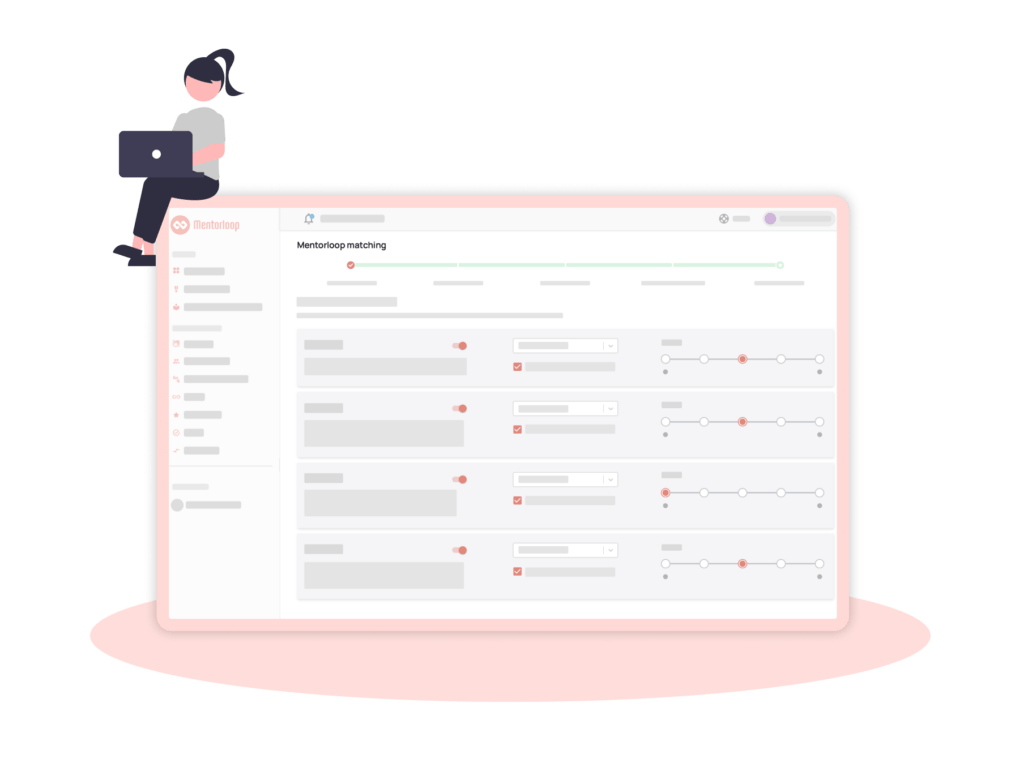
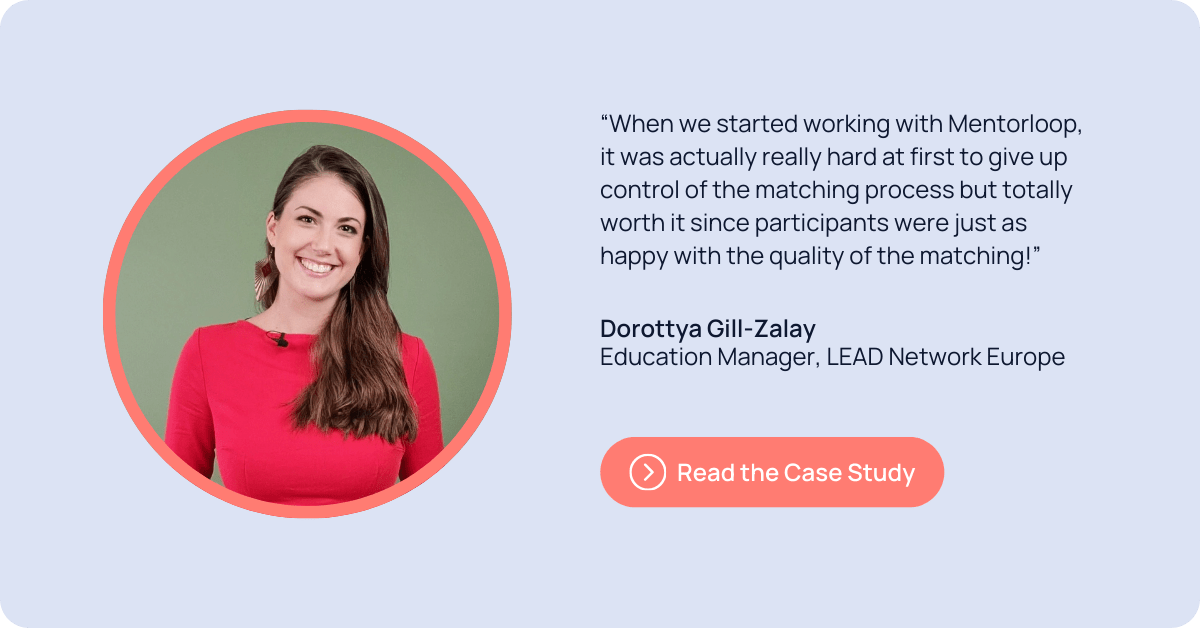
Not the type to completely trust technology? That’s not a problem. Program coordinators can still maintain matching control with Mentorloop’s Match Tuner. It allows program coordinators to calibrate the algorithm by choosing the criteria and weighting by which their cohorts will be matched. After that, all that’s left to do is letting Mentorloop work its magic, then reviewing draft matches before setting them live.
Choosing the Right Matching Method for Your Program

In the end, there is no one-size-fits-all solution for matching mentors and mentees. Depending on the goals of your program and the resources at your disposal, any of the above methods may be effective. The key is to establish a clear set of matching criteria, communicate those criteria effectively, and track progress along the way. By taking the time to thoughtfully match mentors and mentees, you’ll set your program up for success and ensure that both mentors and mentees have a fulfilling and productive experience.

Frequently Asked Questions on Matching Mentors and Mentees

What is the best way to match mentors and mentees?
There’s no single best method. The right approach depends on your program’s size, goals, and resources. Smaller programs often do well with manual matching, where a coordinator personally reviews and pairs participants. Larger programs benefit from algorithmic matching, which removes unconscious bias and scales without sacrificing quality. Some programs use a combination: letting Smart Match generate draft pairings, then giving coordinators the opportunity to review before they go live, for example.

The most commonly used matching criteria are: experience level, professional goals, availability and time commitment, skills the mentee wants to develop, and (where relevant) location or time zone. Some programs also factor in diversity and inclusion considerations, or shared interests, to strengthen the connection beyond professional alignment.

Yes! Participant-driven matching, or Self Match, is a valid and often highly effective approach. It gives participants more ownership over their mentoring experience and tends to result in stronger engagement. The trade-off is that participants may gravitate toward people similar to themselves, which can limit exposure to new perspectives. Clear guidelines and any necessary guardrails (such as restricting cross-department matches) help offset this.

Smart Match is the most effective way to remove unconscious bias from the matching process. Rather than relying on a coordinator’s instincts or a participant’s personal preferences, the algorithm, together with Mentorloop Intelligence, matches based on objective criteria (e.g. skills, goals, experience, etc.) and can be weighted to prioritise diversity and inclusion. Human review can still be applied at the end, but the initial match is bias-free.

Even well-considered matches don’t always result in a strong relationship. The most important thing is to have a clear process for participants to flag a match that isn’t working, and for coordinators to be able to re-match without friction. Mentoring software makes this significantly easier than managing it manually.

Learn more about troubleshooting mentoring matches

Keen to see more of Mentorloop’s matching magic? Chat with us and see a demo!

Picture of Grace Winstanely
Grace Winstanely
Grace is the Senior Marketing Manager at Mentorloop. She is dedicated to making content that helps make mentoring more accessible to all and helping Program Coordinators deliver the best mentoring experience for their participants. She's also a keen cook, amateur wine connoisseur, sports fanatic, and lover of all things tropical.

Share this Article

Join the loop

Get updates and learn from the best mentoring programs

continue Learning

Create a culture of mentoring where your people are always learning, supported, and sponsored to success