
We’ve spent two decades trying to fix managers with more training, better feedback cycles, leadership offsites, coaching budgets, resilience workshops… you name it, it’s been tried.
And yet, here we are: manager burnout is at an all-time high, middle management is being hollowed out, and the people caught in the middle are somehow expected to do more with less.
What if the problem isn’t the managers? What if we’ve been asking the wrong question all along?
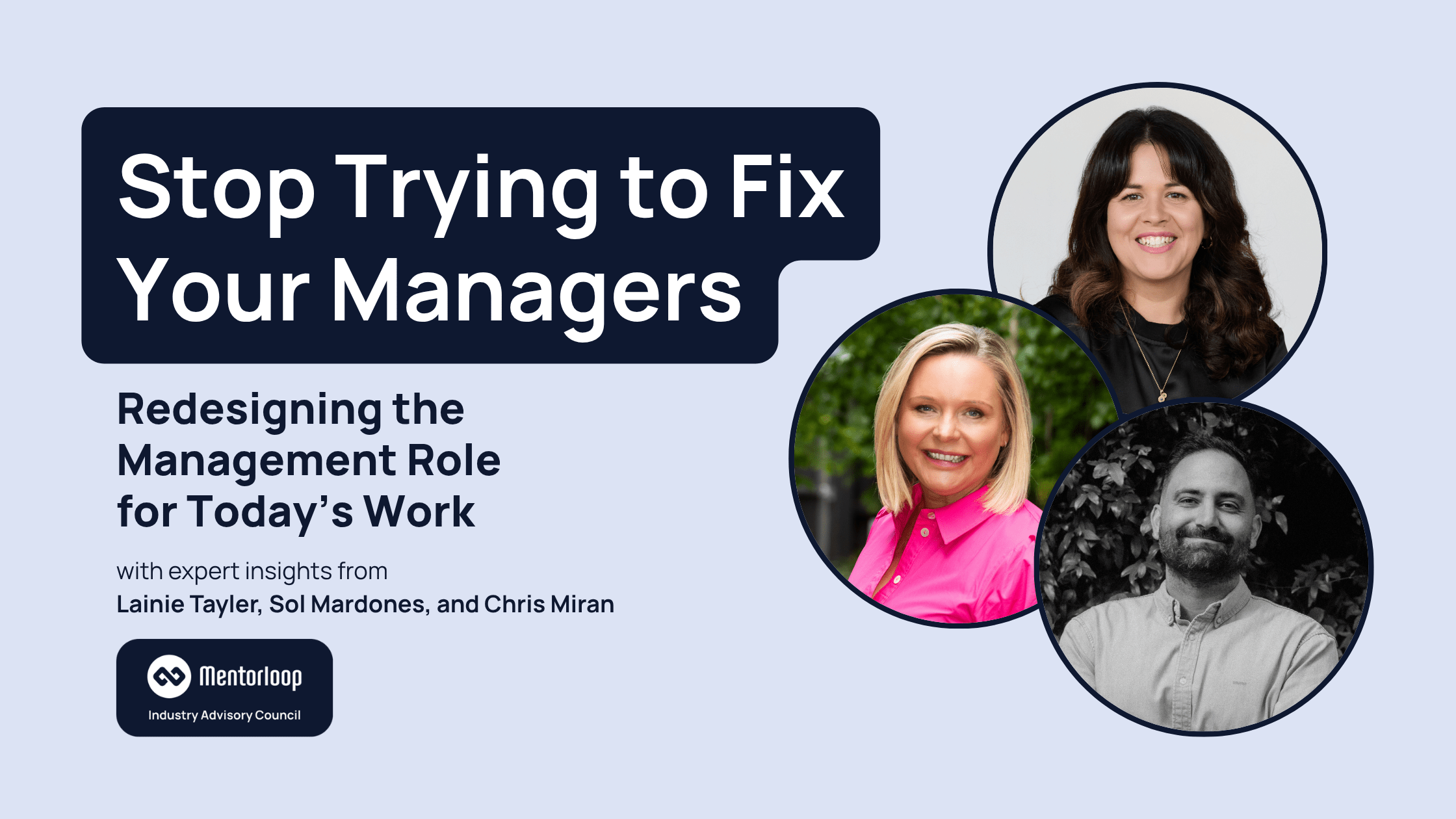
That’s exactly what Mentorloop co-founder Heidi Holmes put to a panel of workplace experts and members of the Mentorloop Industry Advisory Council in a recent webinar: Lainie Tayler (HR Squad), Chris Miran (Thrive Nation), and Sol Mardones (Smiling Mind). The conversation covered what actually broke the management role, how to spend smarter on development, what AI changes about all of this, and what good leadership looks like in a world that keeps shifting under everyone’s feet.
Here’s what came out of it.
Why the Management Role Was Always Set Up to Struggle
The management model we’ve been running was designed for a different era. Factories. Predictable output. Interchangeable roles. We took that model and asked it to handle knowledge workers, hybrid teams, and now the AI revolution.
Chris Miran put the history bluntly: the first org chart was created in 1855. The manager’s original job was to handle complexity that the factory floor worker wasn’t allowed to touch. Everything complex went upward. That model has never really been redesigned since.
Meanwhile, the role has been quietly accumulating new demands for decades. Sol Mardones put it plainly, and if you’ve ever managed people, this will probably sound familiar:
“They’re often neck deep doing the operational work alongside being asked to do the people leadership work. And rather than there being a reduction in their executional work, in many cases the expectations around execution or delivery increases.”
Flatter structures, hybrid teams, wellbeing expectations, DEI accountability, and now AI, are all stacked on top of a role that was already struggling under the weight of its original design.
Lainie Tayler added another dimension that often gets overlooked: employees themselves have changed.
The expectation employees now place on their manager around development, wellbeing, psychological safety, and clarity is substantially higher than it was even ten years ago. The role’s job description hasn’t kept pace with what’s being asked of it from any direction. This is part of what drives the broader employee experience challenge that organisations are grappling with today.
As Lainie put it, “Employees are asking for more in all these areas as well, and we probably haven’t looked at the design and build of that,” pointing to a generational shift in how employees manage up, and what they now expect from the people leading them.
We Designed a Response to a Design Failure, and It Also Failed
During the session, Mentorloop Co-Founder Heidi Holmes cited an Oxford study of 46,000 workers that found resilience training showed no measurable improvement, and in some cases even made participants worse.
So as a whole, we responded to a structural design failure with an individual-level solution which also turned out to be another design failure. No wonder it didn’t work.
And now budgets are tighter. HR teams are being asked to do more with less. So the question becomes: What do you do? How do you spend smarter?
Chris Miran pointed to research by Robert Kegan and Lisa Laskow Lahey on adult development, which identifies three conditions required for real learning to take hold:
- Clarity about your own development and where your edge is
- The right support — coaches, mentors, peers — around you
- The practices that embed learning into your actual habits and ways of working
What most organisations invest in is the program itself: the event, the content, the nice hotel. And those things aren’t bad. But the third condition, the ongoing support and practice embedded in daily work, gets almost no attention. And without it, the learning doesn’t stick. Chris explains why:
Sol added something that’s easy to miss when budgets are tight and you’re under pressure to just do something: not every problem is a development problem, and spending without diagnosing first is how budgets disappear without results.
As Sol put it: “Sometimes we can’t solve systemic struggles by focusing on individual development, so understanding really clearly what is the challenge the organisation is facing: is this requiring a systemic redesign, or is it really about supporting individual people with specific learning?”
In other words, the ROI on your L&D spend for your managers depends entirely on whether you’ve correctly diagnosed the problem first. Getting that diagnosis right is what determines whether your budget actually moves the needle.
What Does the Manager's Role Actually Look Like Now?
If we’re adding new expectations like team engagement targets, AI literacy, and psychological safety to the manager’s role, something has to go. But what, specifically?
Lainie Tayler uses a coaching exercise with managers that makes the answer pretty clear, pretty fast. She asks them to document only the things that only they can do. The tasks they genuinely can’t delegate up or down. Here’s what happens:
From her experience, what usually happens is they list a series of operational tasks and then write a single line about the actual people leadership side. It’s a visual representation of where time is actually going and where the role is most misaligned with what the organisation actually needs.
The goal of that exercise isn’t blame. It’s clarity about what the manager thinks their role is, what their leader thinks it is, and where those pictures don’t match.
The Capacity and Capability Distinction
This is where a distinction that often gets missed becomes really important.
Sol makes the case that in many environments, there’s confusion around what’s a capacity issue and what’s a capability issue.
She highlights that we can give people, managers in this case, the skills they need and therefore building their capability, but if they can’t find the capacity to use those skills because of the way their role is designed, they’re never going to be able to apply what they’ve learned.
One of the most practical ways to create that capacity is through technology, but not as a replacement for human judgement — as a way to free it up.
The People Work IS the Real Work
An audience question cut to the heart of it: leaders often feel like they have two jobs: the “real” work, and the people work. How do you shift the mindset so managers realise that building the team is the core job?
Sol’s answer started with subtraction. Before you can ask a manager to step into something bigger, you have to create space for them to feel like they can. That means looking honestly at what they’re carrying: what can be delegated, what can be redesigned, what only they can actually hold. It’s not a criticism, it’s a design question.
Chris pushed it further: the way a manager leads usually reflects how they themselves are led. If their own leaders are genuinely curious about them as people, invite them to experiment, and treat the work and the people as inseparable, that becomes the model they carry into their own teams.
“It’s not that the work is separate from the people. The people and the work go together. It’s just that we’ve thought about it that way for a long time.”
— Chris Miran
The practical implication is that if you want managers to show up as leaders of people, make sure the people leading them are doing the same.
How Should We Be Measuring Managers' Performance?
But redesigning the role only works if you also redesign how success is measured. If the role is changing, so should how we define good.
Sol’s view is that team engagement should be a performance indicator for managers. Not in a punitive sense, but because if engagement matters to the organisation, it needs to be tied to reward and recognition. Lainie also adds that if all the rewards and recognition is around other things (e.g. delivery and output only), then it’s very hard to shift culture from something theoretical to something that is practiced and lived.
Understanding what actually motivates teams and measuring against it, rather than just output, is part of how the role evolves.
Sol explains what that actually looks like in practice:
Sol also shared a few concrete capability markers worth measuring:
- A manager’s ability to maintain clarity and alignment in the face of ambiguity
- Their ability to foster genuine psychological safety
- Whether people in their team feel seen, cared about, and connected enough to go above and beyond
These aren’t soft metrics. They’re leading indicators of retention, engagement, and performance. The challenge is treating them that way.
Beyond engagement, Chris also suggested measuring something less conventional: the number of experiments teams are running.
Chris explains why experiments are one of the highest-order things leaders should be tracking:
How to Develop Managers in a Way That Actually Works
So given everything we’ve just covered: the broken model, the misaligned budgets, and the role that’s been asked to do too much for too long, what do we actually do? How do we develop managers for the way we work now, not the way we worked in 1995?
The panel’s answer wasn’t a new program. It was a different philosophy. Lainie said it best:
Generic leadership development is a dead concept. Bespoke, targeted development — focused on one real capability at a time, embedded and built on before moving to the next — is what actually works.
— Lainie Tayler
Lainie also elaborated on what that looks like in practice: “Whether it’s just one capability for the year — embedding that, having the time to embed it, and then going again and building — but being quite specific around the issue that you’re trying to solve versus that very generic leadership. I think that is a dead concept these days, and much better to get quite specific.”
And where that development happens matters just as much as what it covers.
The Case for Team-Based Learning
While there’s value in the traditional individual learning model, the panel was pretty aligned: on-the-job, team-based learning is more effective and most organisations aren’t using it nearly enough. Here’s how they think it should actually be implemented.
Lainie has been shifting her clients toward learning days: a simple, budget-conscious format that surfaces the expertise that already exists inside a team.
As Lainie describes it, “We always look outward in organisations, but often there are amazing people inside who have amazing backgrounds and done amazing things, we just haven’t surfaced them.”
Her approach: designate a couple of days per year as learning days, and use internal talent to build capabilities together rather than always sourcing externally.
Chris takes it even further, arguing that the goal shouldn’t be learning events at all, but learning as a way of working. His challenge to the traditional L&D model is worth sitting with: investment priorities for most organisations are a bit lopsided when it comes to the learning process: the program, the event, the content (which is obviously very important) but the real developmental work happens on the job and there’s little to no investment there. The problem is that embedding learning into actual ways of working is hard, unglamorous, and easy to deprioritise.
His argument is that the best lever isn’t a better program, it’s a clearer shared problem. When people know what they’re collectively trying to solve, the work of solving it creates the learning opportunities.
Sol shared a concrete example of how Smiling Mind puts this into practice and one idea in particular that almost no organisations do, but probably should.
New team members get a peer mentor for their first 90 days. And any significant promotion re-triggers that onboarding process from scratch. It’s a simple structural shift with significant impact. And it scales. The best company mentoring programs tend to be built on exactly this principle: connecting people to knowledge that already exists inside the organisation, at the moments when it matters most.
How AI Fits Into This, And How It Doesn't
AI is a topic that we cannot avoid, and especially in the People or HR spaces, it’s easy to either dismiss it or catastrophise it. Neither is particularly useful right now.
84% of Australian office workers are already using AI. Only 35% have had any formal training. That means managers are already leading AI-augmented teams they may not fully understand and the coordination work that used to justify part of their role is quietly disappearing.
Building a future-ready workforce means addressing that gap deliberately, not waiting until the technology fully outpaces the people leading it. A good starting point is being honest about what AI actually does better. Sol’s take: technology tends to outperform humans on things requiring synthesis and repetition. So the practical question for any manager is: What do I find myself doing every single month that follows a predictable pattern? That’s where automation is worth exploring. What’s left after that is a much cleaner picture of what management was always actually for.
What Only Humans Can Do
When you strip away the coordination, the synthesis, and the repetition, three things remain that AI simply can’t replicate:
Coaching, mentoring, and genuine development conversations
The ability to sit with someone and ask meaningful questions about where they’re stuck, what they want, and how to help them get there. AI can synthesise information. It can’t hold space.
Clarity and alignment in conditions of uncertainty
When strategy is shifting and the external environment is volatile, the manager’s job is to be the human anchor who translates ambiguity into something the team can act on with confidence.
Connection, trust, and belonging
As organisations flatten, there’s real risk of losing the intentional relational work that happens at a team level. The workplace connection crisis is already well-documented and the manager is often the last line of defence against it becoming acute inside a team. People do their best work when they feel safe, seen, and cared about. That’s a human job.
What Could AI Improve?
Most conversations about AI in the workplace start with headcount. Lainie has been pushing her clients to reframe the question entirely and it’s a reframe worth sitting with.
Rather than asking how AI can reduce headcount, Lainie has been challenging clients to ask a different question: “What if we used AI to grow engagement, deliver on the return on investment of our strategy… and that’s how we started to look at it in a safe way for the business?”
Her point: if your engagement scorecard isn’t where you want it, that’s where AI should be pointed first.
Sol’s view is clear on where the framing should start: “At the moment I think [AI is] being seen as a threat because the idea is, ‘Does this enable there to be less managers?’
My truest, most fundamental belief is that is the wrong way to look at designing automation. The goal should be: how does this enable us to have better, more focused managers and to be very clear and intentional about what needs to stay human and what can potentially be supported with technology?”
Heidi also added what might be the most durable framing of the whole conversation: once the technology gets commoditised (and it will) the number one differentiator comes back to people.
The ability to lead with empathy, to build trust, to create environments where people genuinely want to contribute. Technology can’t and won’t be able to do this but people can and will.
What Redesigning Good Management Looks Like in Practice
Managers can’t redesign their own roles while they’re drowning in them. That work has to be led from above, but it shouldn’t be done to them. The panel was consistent on this: the redesign process itself should model the culture you’re trying to create. Start by asking, not telling.
Chris recommends beginning with what he calls a “kill list,” giving teams permission to name the bureaucratic friction that gets in the way of doing good work. It’s a simple exercise, and it costs nothing. Chris shares how he’s used it:
Sol adds that the questions you ask in this process matter enormously because the people closest to the work already know what’s broken.
Sol recommends going directly to your managers with three questions:
- What are you doing right now that you think could be automated?
- Where do you feel we’re over-relying on individuals instead of designing better systems?
- What are the human capabilities we all believe we should be fostering and growing in our leaders?
As Sol puts it, asking those questions “allows you to not only see what they think their job should be, but also to hear from people what they need from the people that lead them, to do well and to feel successful.”
But none of this consultation works without clear direction from the top.
Lainie is direct about where the accountability sits
Chris offered a complementary image: for the river to flow, you need strong banks. People can do creative work and experiment and co-design, but they need to know the playground. What’s in scope? What’s not? What does success look like? That clarity is leadership’s job.
What We Know About Where This Is All Heading
When the panel turned to predictions, there was a refreshing honesty about how much none of us actually knows. The pace of change makes confident forecasting feel a little foolish right now.
But two things they agreed on: there’s a lot of uncertainty, and it’s precisely because of this that good, human managers and leaders will matter more than ever, not less.
The idea that the manager role will quickly shrink didn’t get much traction. What the panel did agree is that it will change shape. Chris expects spans of control to widen as structures flatten, which means fewer managers, each carrying more responsibility for more people. The capability that will matter most isn’t knowing all the answers. It’s building systems and cultures that can handle not knowing.
Lainie put it simply: the leaders who will hold things together in the years ahead aren’t the ones with perfect clarity. They’re the ones who can stay steady while everyone else is still finding the questions.
They also agreed on the need for caution. Heidi closed with a line from an article she’d read the day before the webinar, and it’s probably the best summary of the challenge ahead: “Speed without clarity produces chaos rather than transformation.”
That’s the real task for every organisation right now. Not moving faster. Not adding more to the manager’s plate. Building the clarity — the system, the role design, the conditions for learning — that makes the speed mean something.
This post is based on Mentorloop’s webinar, “Stop Trying to Fix Your Managers,” featuring Lainie Tayler (HR Squad), Chris Miran (Thrive Nation), and Sol Mardones (Smiling Mind). Watch the full recording here.
Interested in how mentoring fits into a redesigned management model? Explore how Mentorloop works or book a demo.